
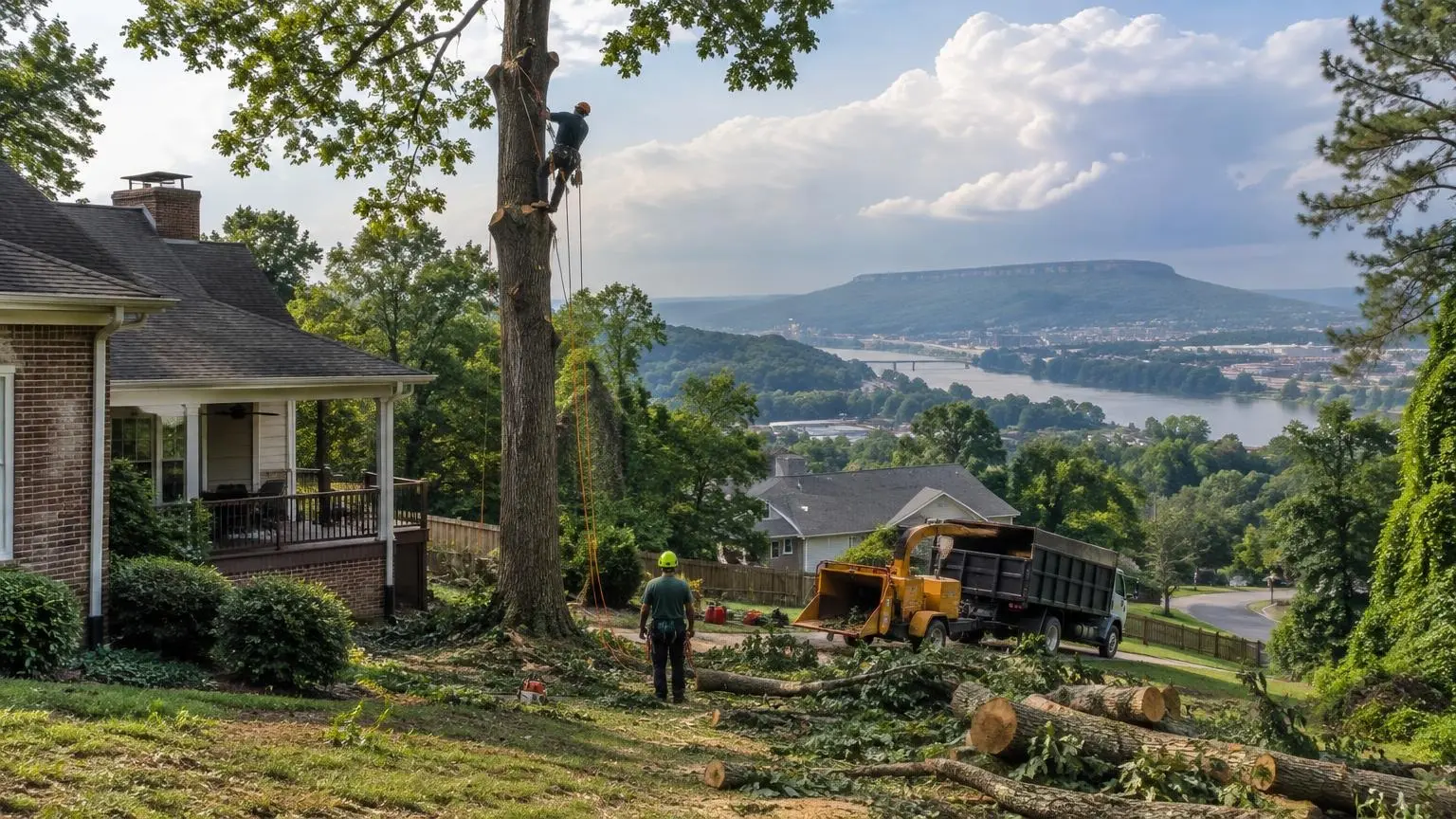
Is that tree sick, or just ugly?
Tree Health Assessments in Chattanooga, TN
A plain answer about a tree's condition and your real options: treat it, prune it, watch it or take it down.
- We come out and look before we price, anywhere in Chattanooga and nearby towns
- Every task on the quote has its own line
- Haul-off spelled out on the quote
Reading a Tree Before Deciding Its Fate
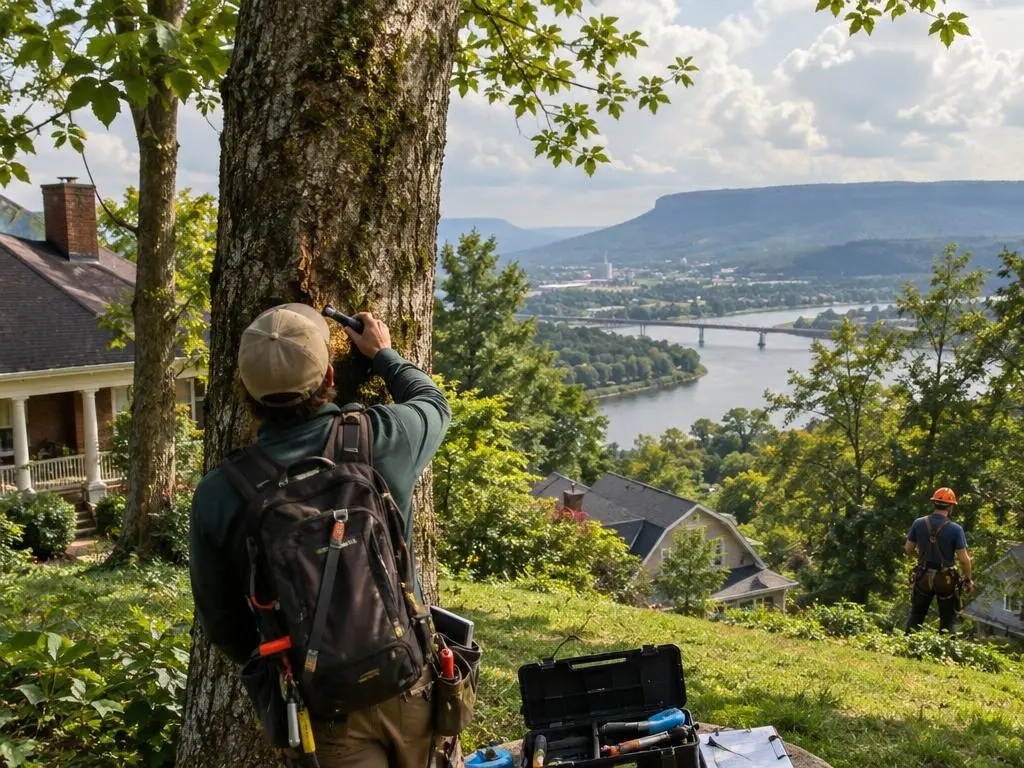
Tree health assessments answer the question homeowners actually have: is this tree going to be a problem, and what can I do about it? Around Chattanooga, the answer often depends on knowing a handful of local pests and diseases by sight, along with the usual structural warning signs. We walk around the tree, look at the trunk, the root flare, the bark and the crown, and tell you what we see in plain language, with the options laid out: treatment, pruning, monitoring, or removal.
Hemlocks and woolly adelgid
Eastern hemlocks grow in the cool, shaded ravines and north-facing slopes of Signal Mountain, Lookout Mountain and the creeks that run off them. Hemlock woolly adelgid is the biggest threat they face. The insects leave small white tufts, like bits of cotton, on the underside of twigs at the base of the needles, and infested trees fade to grayish-green and thin out. A 2009 Forest Service study warned that the adelgid could kill most hemlocks in the southern Appalachians within a decade. A tree with most of its needles left can often be protected with a systemic insecticide such as imidacloprid, applied as a soil drench or trunk injection, which can work for several years. A tree that is mostly bare is usually past saving and, near a house, may need to come down. If treatment is the better route, we explain what it involves and how often it has to be repeated.
Pines and southern pine beetle
Loblolly, shortleaf and Virginia pines are common on Chattanooga lots, especially along wooded edges. Southern pine beetle goes after stressed pines first, including trees damaged by storms, crowded stands and pines weakened by drought. The telltale sign is pitch tubes: white, popcorn-like lumps of resin on the bark where beetles bored in. Needles that turn yellow, then red-brown, often follow within weeks. There is no practical cure for a heavily attacked pine; prompt removal of infested trees can help protect healthy pines nearby, and keeping pines from being wounded or crowded makes them less attractive targets.
Ash and emerald ash borer
Emerald ash borer has spread across much of the eastern US, including Tennessee. Signs include thinning at the top of the crown, D-shaped exit holes in the bark, woodpecker damage and S-shaped tunnels under loose bark. Without control, ash trees in an infested area are expected to die within about ten years. Valuable ash can be protected with systemic insecticides, which last one to three years depending on the product; ash that is already declining is usually better removed while the wood is still sound.
Decay, lean and storm damage
Not every problem is a pest. We look for mushrooms or conks at the base, hollow sounds and cavities in the trunk, cracks and included bark at forks, roots cut by past construction or grading, and soil heaving on one side of a leaning tree. On hillside lots we pay attention to erosion around roots and to trees whose root zones have been buried by fill. Trees wrapped in kudzu get a closer look too, since the vine's weight and shade break branches and can pull trees over.
What you get
After the visit you get a clear recommendation and, if work is needed, a written quote. If the right answer is to leave the tree alone and look again next year, we say that.
What an Assessment Looks At
An assessment covers the tree from the roots to the top of the crown and the targets around it.
Hemlock woolly adelgid checks
Branches inspected for white woolly masses, needle loss and color change, with treatment versus removal explained.
Pine beetle inspection
Bark checked for pitch tubes and boring dust, and the crown for fading needles.
Ash borer inspection
Ash checked for D-shaped exit holes, crown dieback and woodpecker stripping.
Structural and decay check
Trunk, forks and root flare examined for cracks, cavities, fungus and lean.
Construction and slope review
Root damage from grading, fill or trenching, and erosion around roots on hillside lots.
Published Arborist and Tree Care Costs
| Item | Published range |
|---|---|
| Arborist consultation or tree inspection (HomeGuide) | $100 to $250 |
| Written arborist report (HomeGuide) | $150 to $450 per tree |
| Certified arborist hourly rate (HomeGuide) | $100 to $250 per hour |
| Tree injection treatment (HomeGuide) | $75 to $250 per tree, or $10 to $15 per trunk inch |
| Follow-up pruning (HomeGuide trimming guide) | $250 to $1,200 for trees up to 60 ft |
National ranges from HomeGuide's arborist and tree trimming cost guides. We do not charge for looking at a tree during an estimate visit; any report, treatment or work that follows is quoted in writing first, and your written estimate is the price.
How an Assessment Works
1. Tell us your concern
Which tree, what you noticed and when it started: thinning, dead limbs, a new lean, mushrooms or sap.
2. Inspection
We look at the roots, trunk, bark, forks and crown, and at what the tree would hit if it failed.
3. Plain-language findings
What we see, what it likely means and the realistic options.
4. Written quote if needed
Pruning, treatment or removal priced per tree, or a note to recheck later.
Tree Health Assessments Questions
Can a hemlock with woolly adelgid be saved?
Often, if it still has most of its needles. Systemic insecticides such as imidacloprid, applied to the soil or injected into the trunk, can protect a hemlock for several years. A hemlock that has lost most of its foliage usually cannot recover, and if it stands near a house or path it may need to be removed.
What are the white lumps of sap on my pine tree?
White, popcorn-like lumps of resin on the bark are pitch tubes, a common sign of southern pine beetle or other bark beetle attack. Many fresh tubes plus fading needles usually mean the tree is dying. One or two old tubes on a healthy tree may mean the tree fought the beetles off.
Is my ash tree worth treating?
It can be, if it is healthy, valuable to you and still has most of its crown. Systemic treatments last one to three years depending on the product, so it is an ongoing cost. Ash that has already lost a large part of its crown is usually better removed while the wood is sound.
Can a tree be checked before I buy a house?
Yes. Buyers often want to know whether big trees near the house are sound before closing, especially on wooded or hillside lots. Tell us what you need it for, and we will look at the trees and tell you what we see.
Is a tree with mushrooms at the base dangerous?
Mushrooms or shelf-like conks at the base or on the trunk usually mean wood decay inside. How far it has gone matters, and that takes a closer look. A tree with decay at the base that leans toward a house or street deserves prompt attention.
Tree Health Assessments Service Areas
- Tree Service in Chattanooga, TN
- Tree Service in East Ridge, TN
- Tree Service in Red Bank, TN
- Tree Service in Signal Mountain, TN
- Tree Service in Lookout Mountain, TN
- Tree Service in Soddy-Daisy, TN
- Tree Service in Collegedale, TN
- Tree Service in Ooltewah, TN
- Tree Service in Harrison, TN
- Tree Service in Hixson, TN
- Tree Service in Walden, TN
- Tree Service in Lakesite, TN
- Tree Service in Middle Valley, TN
- Tree Service in Apison, TN
- Tree Service in Cleveland, TN
- Tree Service in Jasper, TN
- Tree Service in Fort Oglethorpe, GA
- Tree Service in Ringgold, GA
- Tree Service in Rossville, GA
- Tree Service in Lookout Mountain, GA
- Tree Service in Chickamauga, GA
- Tree Service in LaFayette, GA
- Tree Service in Trenton, GA
- Tree Service in Dalton, GA
- Tree Service in Tunnel Hill, GA
Get a Tree Health Assessments Estimate
Free estimate visits for trees that worry you.